
Car Lease, Car Loan, or Car Rental – Which Should You Choose?
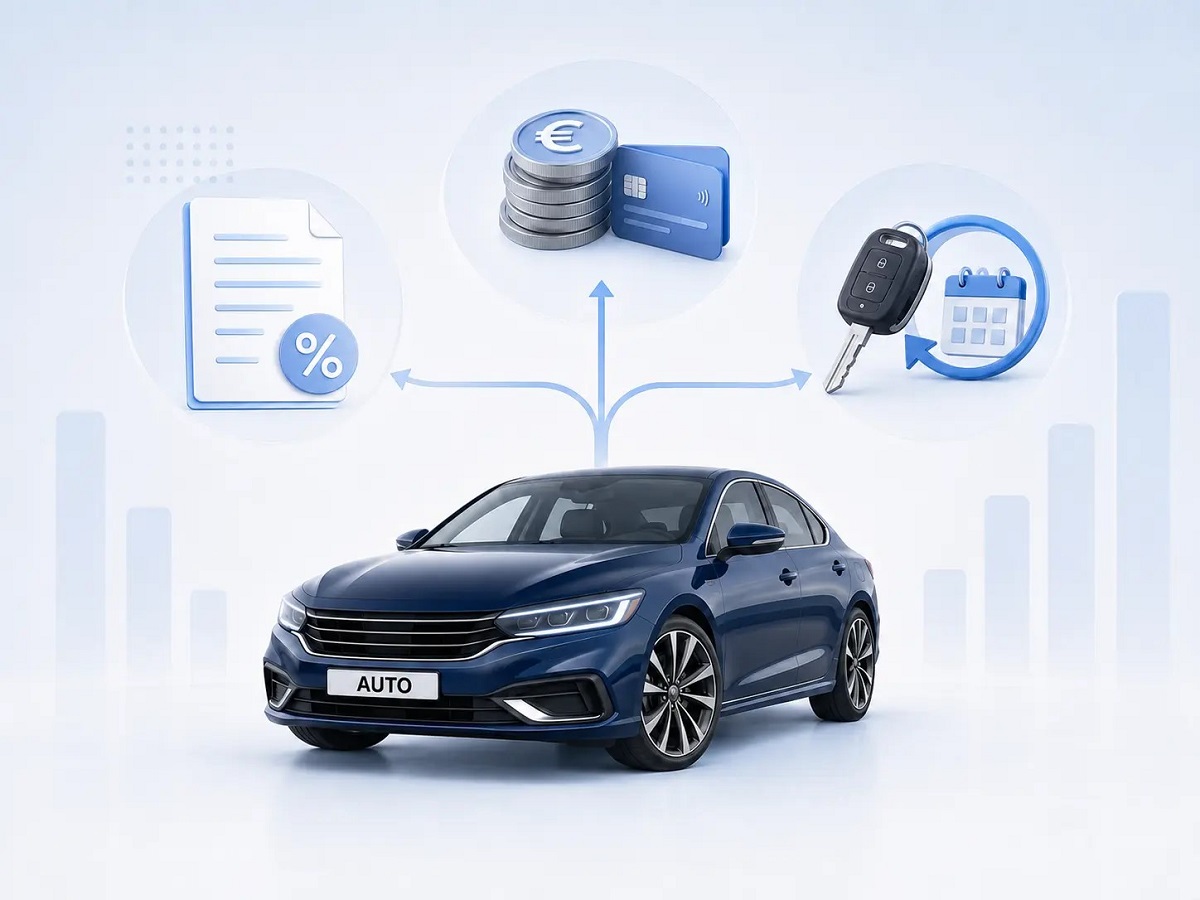 There are several ways to finance a car. Leasing usually suits buying a newer, more expensive car, a car loan gives you more freedom in choosing your car, and long-term rental lets you use a car without owning it. The right solution depends on the car's price, age, how long you plan to use it, and whether you want to become the owner in the end.
If you are considering leasing, you can use our car lease calculator to calculate an approximate monthly payment.
Leasing
With leasing, the leasing company buys the vehicle and you use the car in exchange for monthly payments. A down payment is usually required, and the car must have comprehensive (casco) insurance for the entire lease period.
Finance lease
- Suits you if you want to become the owner of the car once the contract ends.
- The full price of the car is paid over the lease period, or part of it is left as a larger final payment.
- The interest rate usually consists of the Euribor and a personal interest margin.
- A down payment and comprehensive insurance are generally required.
- You become the owner of the car after all payments under the contract have been made.
Operating lease
- Suits you if you want a lower monthly payment and the option to return the car at the end of the term.
- An agreed residual value remains at the end of the contract.
- At the end of the term, it may be possible to return the car, buy it out, or sell it to a third party.
- The exact options depend on the lease agreement and the dealer's buy-back obligation.
- The car's market value at the end of the contract may be higher or lower than the residual value.
Car loan
With a car loan, you buy the car in your own name. This can suit, for example, buying an older or cheaper car, or a situation where leasing terms are not suitable for the chosen vehicle.
- A down payment is usually not required.
- Comprehensive insurance is generally not mandatory.
- The car is registered in your name immediately.
- The interest rate is usually higher than for leasing.
- The interest rate may be fixed for the entire loan period.
- There are usually fewer restrictions on the car's age and seller than with leasing.
- When comparing offers, look at the annual percentage rate and the contract fee in addition to the interest rate.
Long-term car rental
With long-term rental, you pay a fixed monthly fee to use the car. A full-service rental payment may also include maintenance, repairs, tyre changes, and insurance, but the exact scope of services depends on the provider and the contract.
- You do not need to take out a car loan or lease to use a car.
- Car-related costs may be easier to predict.
- The car remains the property of the rental company.
- You need to take into account the permitted mileage and any excess mileage fees.
- The terms and fees for early termination depend on the contract.
- Over the long term, rental can be more expensive than owning a car.
How to choose?
- Choose a finance lease if you want to become the owner of the car once the contract ends.
- Choose an operating lease if you want a lower monthly payment and the option to trade in or return the car at the end of the term.
- Choose a car loan if you want the car registered in your name immediately and more freedom in choosing your car.
- Choose long-term rental if you prefer simply using a car with as little involvement as possible in maintenance and later resale.
What to consider when comparing offers?
Do not compare only the size of the monthly payment. Also look at the down payment, contract fee, interest rate, annual percentage rate, insurance costs, residual value, mileage limit, and the terms for early termination of the contract.
How much would your car lease payment be?
Enter the car's price, down payment, lease period, and residual value to see an approximate monthly payment.
Open the car lease calculator